


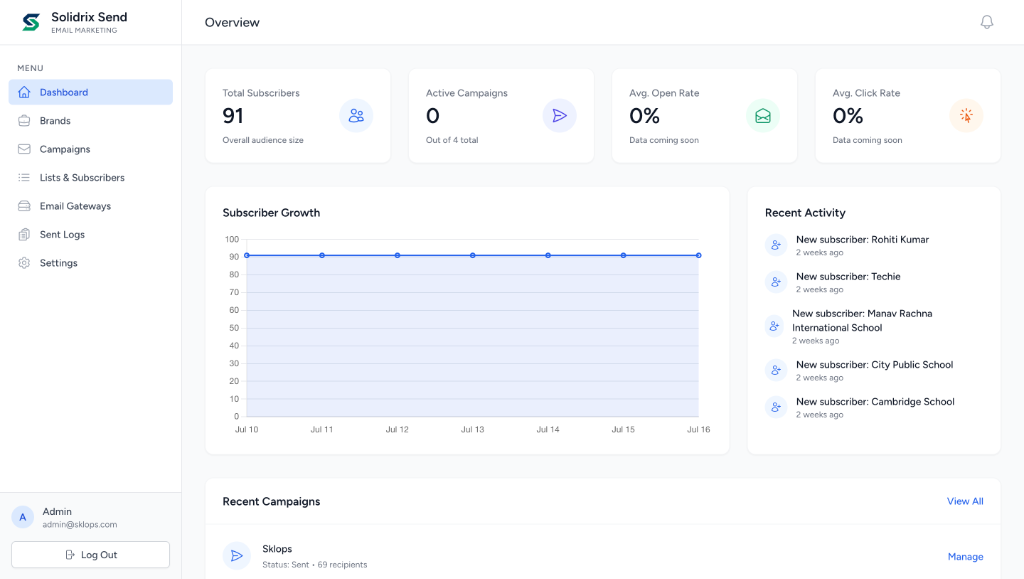
Executive Summary: How Solidrix Send handles high-volume transactional email delivery with dynamic provider failover, bounce parsing, and webhook callbacks.
Transactional email deliverability (password resets, OTPs, invoices) directly impacts business operations. Relying on a single SMTP gateway creates a single point of failure if the provider experiences downtime or IP throttling.
In Solidrix Send (https://send.solidrix.com/), we built an intelligent routing engine that distributes email dispatches across multiple tier-1 SMTP providers (Amazon SES, SendGrid, Postmark, Mailgun):
1. Provider Health Scoring: Monitors live delivery success rates, bounce rates, and latency for each configured SMTP channel.
2. Automatic Dynamic Failover: If Provider A returns a 5xx error or connection timeout, the email is instantly re-routed through Provider B without dropping the message.
3. Queue Processing with Redis: Incoming HTTP API dispatch requests are acknowledged immediately with a UUID tracking token and queued in Redis for async delivery.
Delivery status notifications (Delivered, Bounced, Opened, Spam Complaint) are parsed via incoming webhooks from each provider:
Normalized event payload structure across different provider formats.
Real-time notification dispatched back to client webhooks using exponential backoff retry algorithms.
Automatic suppression list management to prevent emailing addresses that generated hard bounces.
99.99% Inbox Deliverability SLA
Average Email Dispatch Latency < 450ms
Zero Single Point of Failure for Critical SaaS Transactional Emails
1. Multi-SMTP Router Architecture
In Solidrix Send (https://send.solidrix.com/), we built an intelligent routing engine that distributes email dispatches across multiple tier-1 SMTP providers (Amazon SES, SendGrid, Postmark, Mailgun):
1. Provider Health Scoring: Monitors live delivery success rates, bounce rates, and latency for each configured SMTP channel.
2. Automatic Dynamic Failover: If Provider A returns a 5xx error or connection timeout, the email is instantly re-routed through Provider B without dropping the message.
3. Queue Processing with Redis: Incoming HTTP API dispatch requests are acknowledged immediately with a UUID tracking token and queued in Redis for async delivery.
2. Webhook Ingestion & Real-Time Event Tracking
Delivery status notifications (Delivered, Bounced, Opened, Spam Complaint) are parsed via incoming webhooks from each provider: