


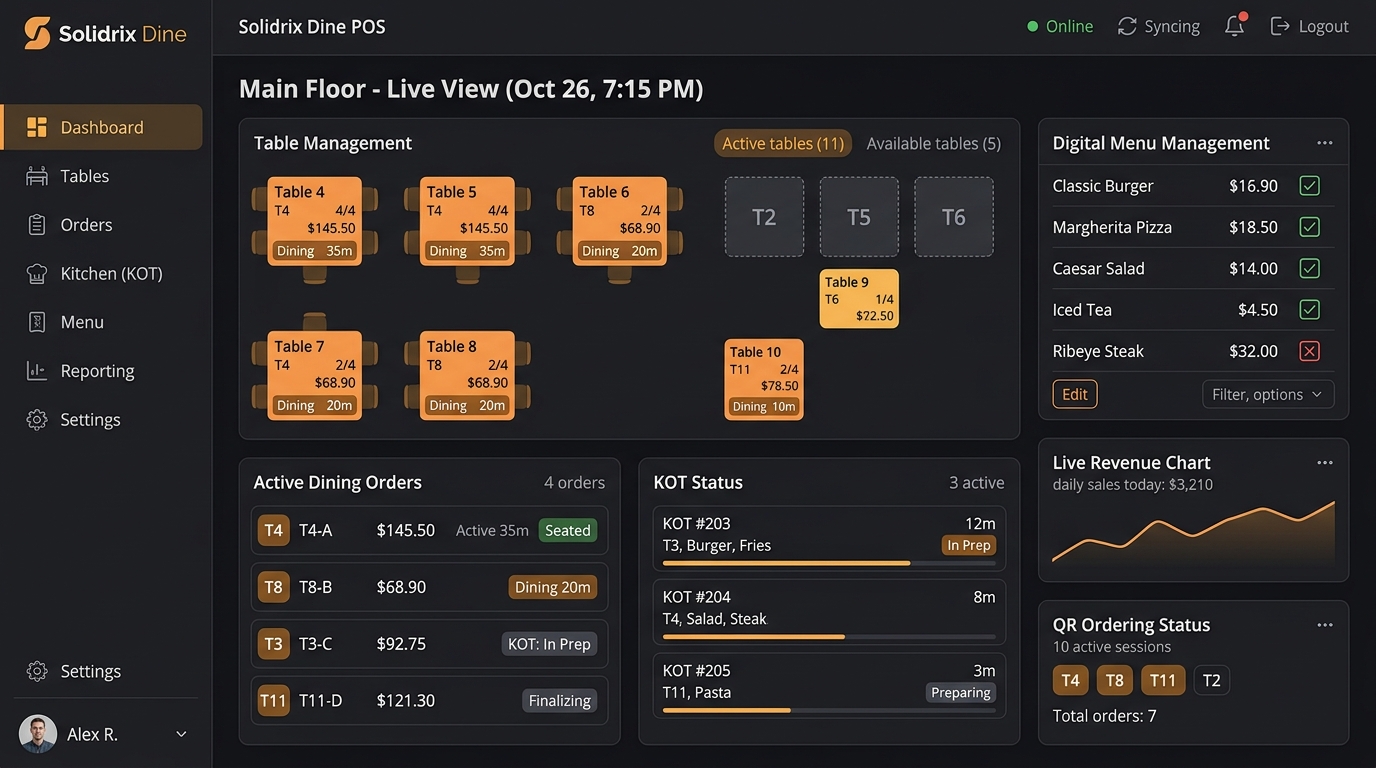
Executive Summary: How we engineered an ultra-low latency restaurant POS and contactless QR table ordering system using React, Node.js, and bidirectional Socket.io synchronization.
In high-volume dining environments, every second counts. A delay of 30 seconds between a captain taking an order and the kitchen receiving the ticket creates bottlenecks during peak lunch and dinner rushes. Traditional desktop POS software installed on local Windows PCs suffers from multi-terminal synchronization lag and cannot bridge the gap to customer smartphone ordering.
When designing **Solidrix Dine**, our objective was clear: build a unified, cloud-native restaurant operations suite where floor captains, billing operators, kitchen stations, and customers ordering via table QR codes all interact with a single, real-time shared state.
### 1. The Core Architecture & Event-Driven Pipeline
Solidrix Dine is built on a modern decoupled stack:
- **Frontend POS & KDS**: React 18 with Vite and Tailwind CSS for instant UI rendering.
- **Real-Time Gateway**: Node.js & Express server paired with Socket.io cluster.
- **Persistence Layer**: MySQL with optimized indexing on table IDs, active order states, and shift logs.
- **Containerized Infrastructure**: Dockerized services orchestrated behind Nginx reverse proxy with SSL termination.
```
[Customer Table QR Code] ──┐
▼
[Captain Mobile Device] ──► [Socket.io Event Gateway] ──► [Redis Pub/Sub]
▲ │
[Cashier Desktop POS] ───┘ ▼
[Kitchen Display Screens (KDS)]
[Thermal ESC/POS Printers]
```
### 2. Instant Bidirectional KOT Synchronization
When a customer places an order via table QR or a waiter taps 'Send to Kitchen', an atomic payload is emitted through Socket.io:
```javascript
// Client-side order emission
socket.emit('order:create', {
tableId: 'table-12',
orderId: 'ORD-9842',
items: [
{ itemId: 104, name: 'Truffle Mushroom Risotto', qty: 2, notes: 'Less pepper' },
{ itemId: 88, name: 'Berry Iced Tea', qty: 2, notes: 'Less ice' }
],
timestamp: Date.now()
});
```
The server validates inventory availability and broadcasts the event directly to the matching preparation stations (Bar Station vs. Main Kitchen):
```javascript
// Node.js Event Routing by Kitchen Station
io.to(`outlet_${outletId}_kitchen`).emit('kot:new', {
kotId: generatedKotId,
tableNumber: table.number,
items: filteredKitchenItems,
urgency: 'normal'
});
```
### 3. Contactless QR Table Ordering with Dynamic Session IDs
To prevent malicious orders and ensure customers only order for their seated session:
1. Each physical table has a unique cryptographic QR token linked to its ID.
2. When scanned, the customer enters an isolated session.
3. Digital carts can be viewed and added to collaboratively by multiple diners at the same table in real-time.
4. When confirmed, the session order merges directly into the running bill for that table.
### 4. Thermal Receipt Printing via ESC/POS Protocol
Restaurant billing requires instantaneous hardware printing. Solidrix Dine supports both raw network socket printing (over local port 9100) and Web USB ESC/POS driver integration, enabling sub-second generation of 80mm kitchen tickets and GST-compliant final tax invoices.
### Summary
By leveraging WebSockets and decoupled reactive micro-components, Solidrix Dine reduces order dispatch latency to under 200 milliseconds, eliminating verbal communication errors between floor staff and kitchen chefs.